
AI Agents for Indian Businesses in 2026: A Practical Guide to Agentic Automation
Learn how Indian businesses can use AI agents for sales, CRM, WhatsApp, email and operations with human oversight, data controls and measurable ROI.

A practical, India-focused blueprint for moving from AI experiments to controlled agents that complete useful business work.
Why AI agents are one of the defining technology trends of 2026
Business AI is moving beyond tools that only answer questions. An AI agent can receive a goal, interpret context, choose from approved tools, complete several steps and report the result. That shift—from generating content to taking controlled action—is why agentic AI has become a major business technology topic in 2026.
Google Cloud's 2026 AI Agent Trends research, informed by more than 3,400 global executives and Google AI experts, highlights multi-agent workflows, personalized customer service and workforce readiness as central themes. Microsoft's 2026 Work Trend Index similarly describes organizations redesigning work so people set direction, agents execute defined tasks and humans remain accountable for quality and outcomes.
India has a particularly strong reason to watch this development. The Government of India is promoting AI and digital adoption for MSMEs through the IndiaAI Mission, while emphasizing safe and trusted AI. For Indian companies, the opportunity is not to install an impressive chatbot. It is to shorten response times, remove repetitive coordination and make everyday operations more consistent without giving software uncontrolled authority.
AI agent vs chatbot vs traditional automation
A chatbot mainly holds a conversation. Traditional workflow automation follows fixed rules such as ‘when a form is submitted, create a lead and send an email’. An AI agent sits between these models: it can understand unstructured input, decide which approved step comes next and use connected systems to pursue a defined outcome.
For example, a website chatbot may answer a pricing question. A rule-based automation may copy the enquiry into a CRM. A controlled sales agent can read the enquiry, identify the requested service, check whether required information is missing, create or update the CRM record, draft a relevant response, suggest an appointment and route unusual cases to a person.
The word ‘agent’ does not mean unlimited autonomy. A production-grade agent should have a narrow role, explicit permissions, reliable data sources, action limits and a human escalation path. The most useful business agents are often deliberately constrained because predictability creates trust.
- Chatbot: answers or collects information inside a conversation.
- Workflow automation: executes predefined steps when a known event occurs.
- AI assistant: helps a person draft, summarize, analyze or decide.
- AI agent: works toward a defined goal using approved data, tools and guardrails.
Six high-value AI agent use cases for Indian businesses
Start where volume, delay and inconsistency already cost the business money. The best first use case has a clear owner, a repeatable outcome and enough activity to measure. It should also be reversible: if the agent is uncertain or an integration is unavailable, the work must safely return to a human queue.
Sales response is a strong example. An agent can classify website, portal and campaign leads; detect likely duplicates; enrich required fields; assign the correct owner; and prepare a personalized first response. The goal is not to send more messages. It is to reduce response time while preserving context for the salesperson.
- Lead qualification agents for real estate, professional services and B2B sales.
- Email operations agents that classify requests, extract details, prepare replies and create tasks.
- WhatsApp automation agents for consented enquiries, reminders, document collection and human handoff.
- Appointment agents that coordinate availability, confirmations, rescheduling and no-show follow-up.
- CRM hygiene agents that identify missing fields, stale opportunities, duplicate records and overdue actions.
- Customer-service agents that answer from an approved knowledge base and escalate exceptions with a complete summary.
The five-layer architecture of a reliable business agent
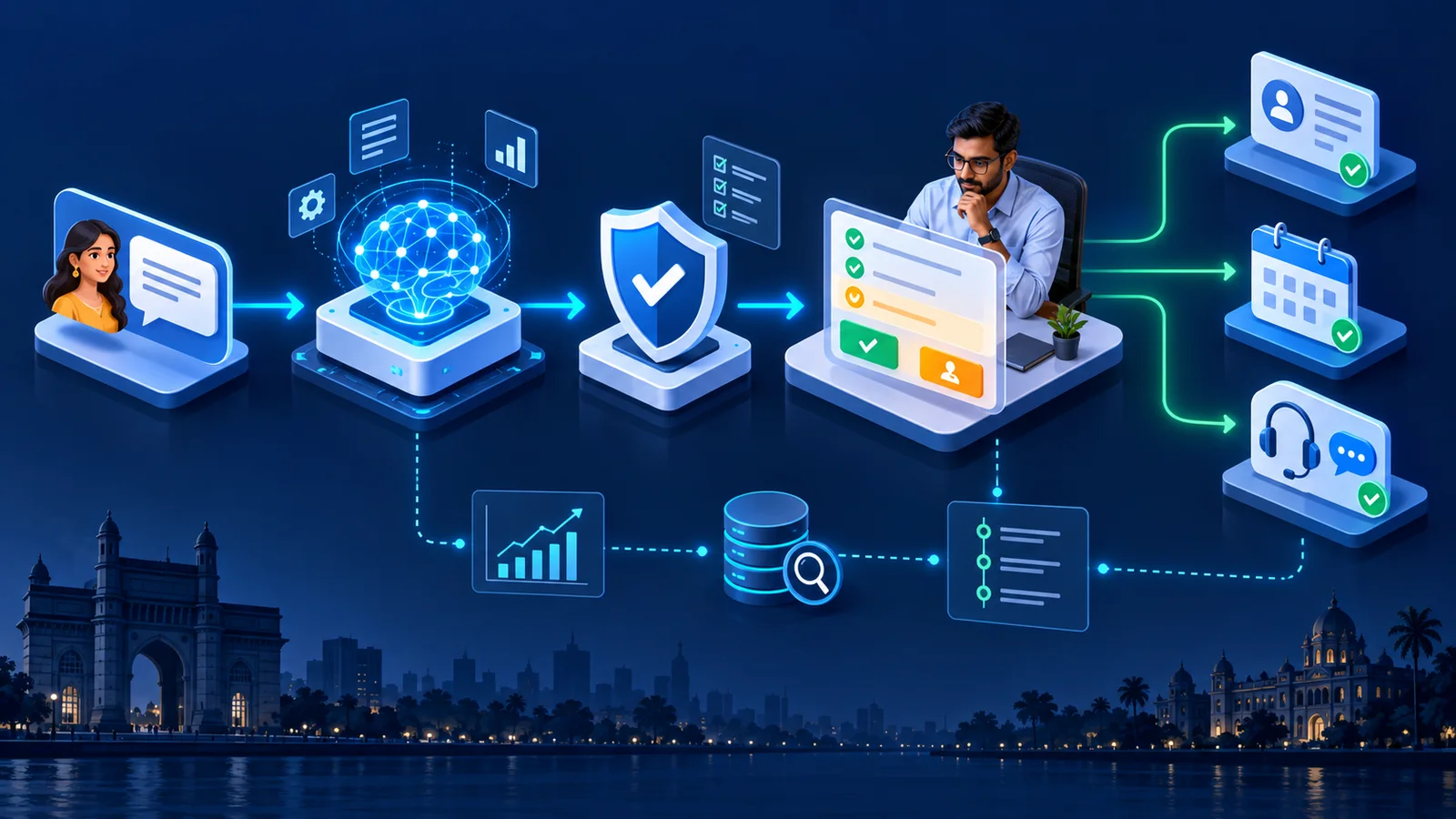
A useful agent is a system, not a single prompt. The first layer is the trigger and context: a new enquiry, incoming email, scheduled check or employee request. The second is trusted business data, such as a product catalogue, CRM record, policy library or availability calendar. The agent should know which source is authoritative and what to do when information conflicts.
The third layer is reasoning and task planning within a narrow scope. The fourth is the action layer: APIs or integrations that allow the agent to create a task, update a field, draft a message or book a slot. The fifth—and most frequently overlooked—is the control layer. Permissions, approval rules, logs, cost limits, evaluations and exception handling determine whether the system can be operated responsibly.
Separating these layers makes the automation easier to test and change. A company can replace a model, CRM or communication provider without redesigning every business rule. It also makes failures diagnosable: teams can see whether a problem came from the input, data, decision, integration or approval process.
Where human approval must remain mandatory
An agent should not make every decision simply because it technically can. Human approval is appropriate when the action has financial, legal, reputational or safety consequences; when the data is incomplete; or when a customer asks for an exception. The approval screen should show the source information, proposed action, confidence or reason for escalation and the exact change that will occur.
Low-risk and reversible work can often run automatically after testing. Examples include tagging an enquiry, creating an internal task or drafting a response. High-impact work—issuing a quotation, changing a price, approving credit, sending a legal statement, deleting data or making a payment—should require explicit authorization and stronger access controls.
Microsoft's 2026 research emphasizes evaluation infrastructure: who reviews agent performance, who can change workflows and how learning is captured. Those questions are practical governance, not corporate paperwork. If ownership is unclear, small errors can be repeated at machine speed.
Data protection and responsible AI in India
AI agents frequently touch names, phone numbers, email addresses, messages, documents and transaction histories. Indian businesses should design these workflows with the Digital Personal Data Protection Act and the notified DPDP Rules in mind. Legal applicability and compliance decisions require qualified advice, but good technical design can support responsible handling from the beginning.
Collect only the data required for the stated workflow. Tell customers why it is being used, maintain appropriate consent or another lawful basis where required, restrict employee and agent access, protect credentials, define retention periods and keep a usable process for correction or deletion requests. Sensitive secrets should never be pasted into prompts or stored in unprotected logs.
Third-party model, messaging, CRM and cloud providers must be evaluated as part of the system. Document where data travels, how long providers retain it, whether it is used for training, which regions process it and how an incident would be handled. Responsible AI is not a one-time checklist; it is ongoing monitoring of outputs, permissions and real customer impact.
- Give each agent a unique identity and the minimum permissions it needs.
- Mask or remove personal data before model processing when full detail is unnecessary.
- Encrypt data in transit and at rest, and store API credentials in a secrets manager.
- Log important actions without creating a second uncontrolled copy of customer data.
- Provide clear opt-out and human-support paths for customer-facing automation.
A practical 90-day agentic automation roadmap
Days 1–15 should be spent mapping one workflow. Record the trigger, inputs, decisions, systems, owner, exceptions and current performance. Establish a baseline for response time, completion rate, manual effort, errors and customer outcome. If the process cannot be explained clearly, it is not ready for an agent.
During days 16–45, build a controlled prototype using sample or limited production data. Connect the minimum number of tools, keep consequential actions behind approval and create a test set containing normal cases, incomplete requests, conflicting instructions, prompt-injection attempts and system failures. A successful demo is not the same as a reliable workflow.
During days 46–75, run a limited pilot with one team and a small volume. Review agent decisions daily, compare them with the baseline and track every manual correction. During days 76–90, improve the weak points, document the operating procedure, train owners and decide whether evidence supports scaling. Expansion should follow measured reliability, not enthusiasm.
How to calculate ROI without inventing savings
Measure the complete outcome rather than the number of messages generated. If an appointment agent creates more bookings but also increases no-shows, it has not necessarily improved the process. If a support agent closes tickets quickly but customers reopen them, the apparent efficiency is misleading.
A useful calculation combines employee time saved, faster cycle time, additional completed outcomes and avoided errors, then subtracts model usage, messaging, software, integration, monitoring and review costs. Include the human time required to correct mistakes. Compare at least four weeks of stable pilot data with the pre-automation baseline before claiming a return.
- Median time from trigger to completed outcome.
- Percentage completed without correction or escalation.
- Customer response, conversion, attendance or resolution rate.
- Cost per successful outcome, including human review.
- Error severity, data incidents and unauthorized-action count.
Warning signs that a process is not ready for an AI agent
Do not automate a broken or disputed process. Warning signs include missing ownership, constantly changing rules, poor source data, no reliable integration, undefined consent, no way to reverse an action and an expectation that the model will ‘figure it out’. These conditions turn uncertainty into operational risk.
Avoid broad ‘AI employee’ projects that begin with a job title instead of a workflow. A safer approach is to define a small portfolio of capabilities—such as triaging enquiries, drafting follow-ups and scheduling appointments—with separate permissions and success measures. The system can gain responsibility only after each capability proves dependable.
What a strong AI automation partner should deliver
Whether the solution is built internally or with an AI automation company in Hyderabad or elsewhere in India, ask for a workflow map, data-flow diagram, permission model, test plan, exception process, monitoring design and measurable acceptance criteria. A proposal should name the systems being connected and distinguish a prototype from a production deployment.
The right outcome is not maximum autonomy. It is a controlled digital operating layer that helps employees respond faster, protects customer context and improves a measurable business result. In 2026, companies that learn to supervise agents well will have a stronger advantage than companies that merely add AI to their marketing vocabulary.
AI agent implementation questions
What is an AI agent in business automation?
An AI agent is software that works toward a defined business goal by interpreting context, selecting approved steps and using connected tools. A reliable agent operates within explicit permissions and escalates uncertain or high-impact decisions to a person.
Which AI agent should an Indian small business build first?
Start with a frequent, repeatable and low-risk workflow such as enquiry classification, appointment coordination, CRM task creation or drafting email follow-ups. Choose a process with a clear owner and measurable baseline.
Can an AI agent automate WhatsApp and CRM follow-ups?
Yes, when the business uses approved messaging methods, appropriate consent, clear templates, CRM identity matching and a human handoff. Promotional communication, opt-outs and personal data require careful controls.
How long does an AI automation pilot take?
A focused pilot can often be mapped, built and evaluated in roughly 60 to 90 days. Timing depends on data quality, integration access, security review and the number of exceptions in the workflow.
How should AI agent ROI be measured?
Measure completed business outcomes, cycle time, correction rate, customer results and total operating cost. Compare stable pilot performance with a documented pre-automation baseline instead of measuring message or task volume alone.
Research sources
This original guide was informed by the following primary and official sources.
- AI Agent Trends 2026 — Google Cloud
- 2026 Work Trend Index: Agents, Human Agency and Opportunity — Microsoft WorkLab
- Government promotes AI and digital adoption for MSMEs — Press Information Bureau, Government of India
- Digital Personal Data Protection Rules, 2025 — Ministry of Electronics and Information Technology